

Self-Driving Data for the Databricks Data Intelligence Platform
June 16, 2026

The Hidden Risk Inside Every Databricks AI Deployment
Databricks is building toward a world where agents act on data autonomously. Lakebase unifies transactional and analytical workloads on a single platform. AI/BI Genie lets business users query data through natural language. Agentic workflows are moving from experimentation into production pipelines.
Every one of those systems inherits the quality of the data layer underneath them.
That’s the part of the AI readiness conversation most enterprises are skipping. When a pricing agent queries a metric through Genie, it doesn’t pause to verify whether the upstream data is fresh, accurate, or free from drift. It acts on whatever context it receives. And if that context is wrong, even subtly, the agent is wrong at scale, instantly.
Manual monitoring doesn’t work at agentic speed. Handcrafted rules, threshold-based alerts, dashboards that require someone to check them: these approaches were built for a world where humans were the final arbiter before action was taken. That assumption is disappearing fast. The data layer has become the place where AI reliability gets decided, and most enterprises aren’t ready.
This is what we’re solving, and it’s why Anomalo and Databricks have built the deepest integration in the data quality space.
Why “Integration” Has to Mean More Than Connectivity
At Databricks’ Data + AI Summit, you’ll hear every data quality vendor make the same claim: we support Databricks. Connectivity, the ability to point a monitoring tool at a Databricks table, is table stakes.
Anomalo delivers that baseline easily. Customers can begin monitoring any Databricks table across SQL Warehouse, Hive Metastore, and Spark in minutes, without the extensive, time-consuming configuration that most tools require. But what we’ve built with Databricks goes five layers deeper than connectivity.
The Integration Stack: Five Layers Deep
Layer 1: Monitor Any Databricks Table, Including Lakebase, without Extensive Human Configuration
Anomalo makes it easy to monitor all your Databricks tables, including Lakebase, the production-ready, serverless Postgres database Databricks recently announced that unifies transactional, analytical, and AI workloads on the platform.
Anomalo is a named Lakebase launch partner. We worked closely with Databricks during development, validated the integration in real production environments, and are ready to help customers move from architecture to execution today. As agentic applications increasingly rely on Lakebase as their operational backbone, Anomalo’s automated data quality becomes the trust layer that makes those applications reliable.
Layer 2: Detection Depth Beyond Metadata
Most data quality tools catch freshness, volume, and schema drift. That’s necessary but nowhere near sufficient for production AI environments.
Anomalo uses ML to monitor data at the content level, across billions of rows, without rules to write or thresholds to configure. The system learns what “normal” looks like for your specific data and flags meaningful deviations automatically, adjusting dynamically for seasonality and known business patterns. When an issue surfaces, it’s a real signal, not a noise problem.
This is the foundation that makes the rest of the platform work. An agent that can only detect metadata anomalies misses the content-level shifts that cause the most damage downstream.
Layer 3: Unity Catalog for Bi-Directional Trust Signals
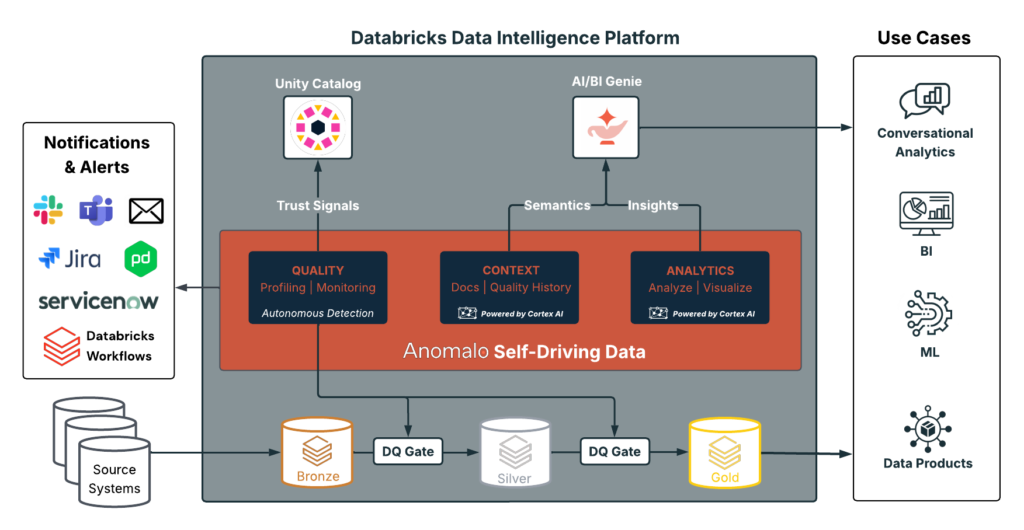
Anomalo’s bi-directional integration with Unity Catalog brings quality context directly into the workflows where governance decisions get made. Data quality issues surface inside Unity Catalog’s Data Explorer. Engineers can investigate and resolve them using Anomalo’s lineage graph, generated from Unity Catalog system tables, and guided root cause analysis.
The result: quality context lives where governance decisions happen, not siloed in a separate monitoring tool that most stakeholders never open.
Layer 4: Unity Catalog Governed Metrics
Anomalo is a launch partner for Unity Catalog Governed Metrics, which combines Databricks’ unified semantic layer with Anomalo’s automated metric monitoring.
For enterprises trying to ensure that the metrics feeding dashboards, models, and agents are accurate and consistent, this matters. Governed Metrics creates a single trusted definition of what a metric means.
Anomalo ensures that the underlying data driving that metric is behaving as expected. Together, they give teams early warning when critical metrics start to drift, before that drift reaches a downstream decision.
Layer 5: Databricks Marketplace
Anomalo is available to try, buy, and deploy directly inside the Databricks UI via the Databricks Marketplace. As one of the earliest Databricks Partner Connect integrations, the experience is designed to get customers from browsing to monitoring in the same session. Anomalo is now available on the Databricks Marketplace. No separate procurement, no integration project needed.
Try Anomalo on the Databricks Marketplace →
Layer 6: Genie and Agentic Workflows
Anomalo’s quality signals surface inside the workflows Databricks customers actually run. When an agent queries a metric through Genie, it inherits Anomalo’s data quality context automatically. The integration isn’t a reporting layer that sits to the side, it’s embedded in the decision-making pipeline, so every query and every action downstream starts from a trusted foundation. And alongside Databricks’ new Unity AI Gateway, which governs agent identity and behavior, Anomalo provides the complementary data reliability layer ensuring the information agents act on is trustworthy before it reaches them.
What This Looks Like in Production
The integrations above aren’t theoretical. Anomalo runs in production with joint Databricks customers across industries, and the pattern across all of them is the same: less time firefighting data issues, more time making data-driven decisions.
A global automotive manufacturer uses Anomalo to monitor thousands of tables feeding production AI systems, catching upstream shifts before they reach models and agents downstream. A leading national fuel retailer built automated quality monitoring across its analytics infrastructure, eliminating the manual checks that previously required dedicated engineering cycles. Lebara, a global telecoms provider, uses Anomalo to drive operational efficiency and improve customer engagement, with automated quality assurance running continuously across their Databricks environment. Nationwide uses Anomalo to automate enterprise data quality at scale, with lineage integration that makes issue triage dramatically faster.
And GM couldn’t have enabled enterprise conversational analytics via Databricks Genie without the underlying agentic monitoring via Anomalo. That’s not a marketing claim, it’s the architecture. Genie gives business users natural-language access to data. Anomalo ensures the data Genie is operating on is trustworthy. Neither delivers on its promise without the other.
The Bigger Picture: Agentic AI Needs an Agentic Data Layer
The AI applications Databricks is enabling downstream require an autonomous data layer underneath them. This is the part of the agentic enterprise story that isn’t getting enough attention.
When AI agents operate manually-monitored data, they inherit that fragility. Rules break when data patterns shift. Thresholds miss what they weren’t written to catch. Alerts fire on noise while the signal goes undetected. And unlike a human analyst who might notice something is off before acting on it, an agent just acts.
Databricks’ new Genie Ontology makes this stakes even higher. It’s the permissions-aware, real-time knowledge layer that powers every query through Genie One drawing from Unity Catalog semantics and learned organizational knowledge to give agents the context they need to act. But an ontology is only as trustworthy as the data underneath it. If the tables feeding Genie Ontology are stale, drifting, or silently wrong, that context is wrong at the source — and every agent query inherits it.
Anomalo is the trust layer that makes Databricks’ agentic capabilities reliable at enterprise scale. The same data profiling and prediction engine that monitors your data quality continuously is the foundation for the Insights Agent, the Data Documentation Agent, the First Responder Agent, a full constellation of autonomous agents that watch your data, investigate changes, document your assets, and surface what matters without being asked.
Three Phases of the Self-Driving Data Platform on Databricks
Think of the journey as three phases, each building on the last:
- Data Monitoring. Conversational data quality, root cause analysis, and natural language check creation via AIDA. This is where most customers start, replacing manual rules and alert triage with automated, AI-driven monitoring that learns your data. The result is faster issue resolution, less engineering toil, and a foundation you can trust.
- Data Understanding. The Insights Agent and Documentation Agent watching your key datasets continuously. Instead of analysts hunting for what changed, the system surfaces meaningful changes proactively, complete with investigation, context, and analyst-grade reports. Documentation that was previously spread across Slack threads, wikis, and institutional memory gets synthesized automatically and kept current.
- Data Analytics. AI/BI integration, AIDA as the conversational interface across the platform, and KPI monitoring that watches your most important business metrics for unexpected movement. This is where the data layer stops being infrastructure and starts actively delivering intelligence.
The full platform moves an organization from Level 1, humans checking dashboards, problems surfacing when stakeholders complain, to Level 4: a self-driving data system where agents handle the monitoring, and your team focuses on the decisions only humans should make.
See Self-Driving Data in Action at Data + AI Summit
Anomalo is at booth #433 at Data + AI Summit. We’re showing the full platform in a live Databricks environment, including the Lakebase integration, the Insights Agent running on real enterprise data, and AIDA as the conversational interface connecting it all.
If you want to see what autonomous data quality looks like in a production Databricks stack, we’d like to show you. Try Anomalo on Databricks Marketplace.
Categories
- Integrations
- Partners
Related Resources
Learn more by browsing our library of announcements, guides, and technical deep dives on data quality.


Ready to Trust Your Data? Let’s Get Started
Meet with our team to see how Anomalo transforms data quality from a challenge into a competitive edge.